.png)


Best Crops for Polyhouse in India (2026)

India feeds 1.4 billion people. It is the world's second-largest producer of fruits and vegetables. And yet, more than 30% of its horticultural produce is lost post-harvest annually — a staggering waste that stems from climate vulnerability, pest pressure, supply-chain inefficiency, and the structural mismatch between seasonal production and year-round market demand.
Polyhouse farming addresses every one of these failures simultaneously. A well-designed polyhouse controls temperature, humidity, light, and irrigation — transforming an unpredictable open field into a precision manufacturing unit for high-value crops. The result: yields 3–5× higher than open fields, dramatically reduced pesticide loads, premium-grade produce that commands superior prices, and the ability to produce off-season when competition collapses and prices peak.
India's protected cultivation area has surpassed 80,000 hectares in 2025 and is growing at approximately 15–20% annually, driven by NHB and MIDH subsidy availability, rising D2C and modern retail demand, and a generation of technology-aware agri-entrepreneurs who view their polyhouse as a business unit rather than a farm.
This guide answers the single most important question for anyone investing in polyhouse farming: which crop do I grow, and will it actually make money? We provide a transparent Profitability Matrix across 12 crop categories, detailed breakdowns of the top 5 performers, IoT and automation considerations, export market opportunities, and a concise business plan framework for a 1-acre polyhouse investment.
Top 5 Most Profitable Crops for Indian Polyhouse (2026)
Cucumber (Parthenocarpic / English) — The Cash King
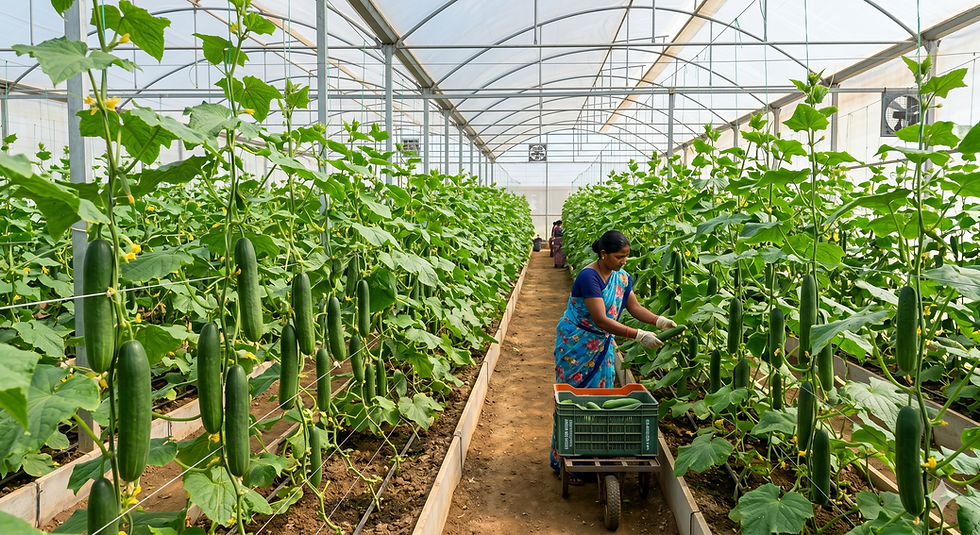
Among all vegetable crops grown in Indian polyhouses, Parthenocarpic cucumber delivers the highest return per day of crop duration. The fundamental advantage: its 75–100 day cycle (vs. 180+ days for tomato) means a farmer can complete two full crop rotations per year on the same polyhouse footprint, compounding the annual revenue.
Why Parthenocarpic? Conventional cucumbers require bee pollination. Inside a polyhouse with restricted insect access, standard varieties yield poorly. Parthenocarpic varieties set fruit without pollination — producing seedless, smooth, export-grade fruits that command ₹15–25/kg vs. ₹8–12/kg for seeded field cucumbers
B:C Ratio: 2.84 — among the highest of any vegetable crop under protected cultivation in India (Sharma, 2024)
Key varieties: Biloxi, Multistar (Enza Zaden), Shakti (Namdhari), Berryland Blue No.1; all royalty-free or widely available through licensed dealers
Yield benchmark: 320–350 quintals per acre per cycle; 640–700 quintals annually with two crops
Technology requirement: Vertical netting trellis (15×15 cm PP mesh at 2.5–3 m height), drip fertigation, 50-mesh insect-proof side netting
Coloured Capsicum (Red/Yellow/Orange)— The HoReCa Premium

Coloured capsicum is the ideal polyhouse crop in India — it simply cannot be grown commercially outside protected cultivation in most of the country. The reasons are straightforward: coloured capsicum requires a long season (6–8 months), is acutely sensitive to temperature fluctuation above 35°C, and its premium price — ₹80–160/kg vs. ₹20–30/kg for green capsicum — is entirely predicated on consistent fruit size, colour saturation, and absence of pest damage: guarantees only a polyhouse can provide.
HoReCa demand: Hotels, restaurants, and cafes are the primary buyers of coloured capsicum in India, paying ₹100–160/kg for Grade A fruits with uniform size (>70g), intact stalk, and vibrant colour. This HoReCa channel is growing at 12–15% per annum driven by the expansion of organised food service
Export opportunity: Indian coloured capsicum is increasingly competitive in UAE, Qatar, and Bahrain markets, where year-round demand for bell peppers supports prices of USD 1.5–2.5/kg (₹125–210/kg). Export farms in Maharashtra and Karnataka are currently supplying Dubai Central Fruits & Vegetables Market (Waterfront Market)
Relative Humidity (RH) requirement: 60–75% RH. Below 50% causes pollen failure; above 85% encourages Phytophthora and Botrytis — RH management is the primary crop management challenge for coloured capsicum
Net profit: ₹6–12 lakh per acre per cycle; B:C ratio 2.2–2.8
Tomato (Indeterminate) — The Volume Leader
India is already one of the world's largest tomato producers — so why grow tomatoes in a polyhouse? Because the yield gap between open-field and polyhouse indeterminate tomato production is transformational: open-field average yields are 20–25 MT/ha; indeterminate polyhouse varieties achieve 80–120 MT/ha — a 4–5× multiplier. Indeterminate varieties are genetically programmed to grow, flower, and fruit continuously — they do not reach a fixed height or stop fruiting at a set time — making them ideal for the sustained, long-duration polyhouse environment.
Economic case: While tomato's B:C ratio (1.49–1.77) is lower than cucumber or coloured capsicum, it compensates with volume. A single 1-acre polyhouse can produce 1,20,000 kg of tomato in 8 months — generating ₹24–36 lakh in gross revenue at ₹20–30/kg premium off-season pricing
Variety selection: Namdhari NS 585 (TYLCV tolerant, suitable for South India), Syngenta Naveen (long shelf life, crack resistant), Nunhems 2571 (fusarium wilt tolerant, long duration)
Trellising requirement: Single-stem training on vertical polypropylene twine; plants topped at 12–14 trusses; critical for light interception and air circulation management
Floriculture (Gerbera / Rose / Lilium) — High-Risk, High-Reward
Polyhouse floriculture represents the highest-revenue and highest-management-intensity crop category in Indian protected cultivation. The financial ceiling is extraordinary — well-managed rose greenhouses in Bengaluru and Pune are generating B:C ratios of 4.5–6.0. But the floor is also lower: crop failure from disease, temperature excursion, or market channel mismatch can result in total loss of a season's investment.
Gerbera: 3.5–4.0 lakh stems per acre annually; excellent for domestic wedding and event market; 18-day vase life enables efficient logistics. Key varieties: Salvadora (red), Mustang (yellow), Cartaya (pink). Perennial crop: single planting productive for 3–4 years
Rose: The premium play. Arka Parimala achieves 5.5–6.0 lakh cut stems/acre/year. Export-grade roses to Netherlands, UAE, and Japan at USD 0.20–0.40 per stem (₹17–33/stem) vs. ₹3–8/stem in domestic wholesale. Productive for 6–8 years; requires climate-controlled or NV polyhouse with supplemental lighting for export standard
Lilium: Bulb crop with 90–100 day cycle; 1.0–1.5 lakh stems per crop; B:C ratio 1.8–2.2. Premium positioning in wedding floristry and corporate events. Bulb import cost (Netherlands) is the main CAPEX driver — ₹15–25 per bulb
Market linkage is non-negotiable: Unlike vegetables that can sell at any mandi, floriculture requires pre-established contracts with florists, wedding planners, exporters, or B2B direct buyers before the first petal opens
Exotic Fruits (Blueberry / Strawberry) — The 2026 Trend Crops
India's premium food retail sector — driven by organised supermarkets, cloud kitchens, D2C subscription boxes, and export demand — is creating a rapidly expanding market for domestic exotic fruits at prices that reward polyhouse investment generously. The two leading crops in 2026 are blueberry and strawberry.
Strawberry — Fast ROI champion: ₹5–7 lakh net profit per acre in a single 4-month season with a B:C ratio of 3.1–3.8. Can be grown under low-tunnels or NV polyhouse. The fastest-payback exotic crop in India; ideal for farmers wanting to build polyhouse management skills before committing to a long-duration crop
Blueberry — The patient investor's prize: Requires a cocopeat grow-bag system (pH 4.5–5.5), strict EC management (< 0.8 dS/m water), and a 3-year patience period before commercial yield. But Year 3+ net profit of ₹37–93 lakh/acre/year at ₹800–1,200/kg makes it potentially the highest-revenue crop per square foot in Indian agriculture
2026 retail market: Domestic blueberry demand is outpacing domestic supply by a factor of 15:1 as of 2025 — imported blueberries retail at ₹700–1,200 per 125g punnet. The first domestic growers to reach scale will capture an extraordinary first-mover margin
The 2026 Polyhouse Profitability Matrix — All Crops Compared
The table below provides a direct, data-driven comparison across 12 crop categories grown in Indian polyhouses. Use this as your primary screening tool before developing a detailed business plan for your specific location and market.
Crop | Investment/Acre (₹) | Cycle Duration | Avg. Yield/Acre | Avg. Net Profit/Acre (₹) | B:C Ratio |
VEGETABLES & FRUITS | |||||
Cucumber (Parthenocarpic) | ₹3.5–5.0 L | 75–100 days | 320–350 quintals | ₹2.15L–3.82L per cycle; ₹4L–7.6L/yr (2 cycles) | 2.84 |
Coloured Capsicum (Red/Yellow) | ₹5.0–8.0 L | 6–8 months | 15,000–20,000 kg | ₹6L–12L per cycle | 2.2–2.8 |
Tomato (Indeterminate) | ₹3.0–4.5 L | 6–8 months | 80,000–1,20,000 kg | ₹89K–1.39L per cycle | 1.49–1.77 |
FLORICULTURE | |||||
Gerbera (Cut Flower) | ₹8.0–12.0 L | 10–12 months (perennial) | 3.0–4.0 lakh stems/yr | ₹5L–9L per year | 2.0–2.5 |
Rose (Indeterminate) | ₹8.65L–11.85L (net) | 8–10 months to peak; 6–8 yr life | 5.5–6.0 lakh flowers/yr | ₹25L–57L/yr (polyhouse) | 4.5–6.0 |
Lilium (Bulb Flowers) | ₹10.0–15.0 L | 90–100 days per crop | 1.0–1.5 lakh stems/crop | ₹3L–6L per crop | 1.8–2.2 |
EXOTIC FRUITS | |||||
Strawberry | ₹2.65L–3.58L | 4 months/season | 80–100 quintals | ₹5L–7L per season | 3.1–3.8 |
Blueberry (Year 3+) | ₹9.7L–15.0L (net) | Year 3 onwards commercial | 5,000–8,000 kg/yr | ₹37L–93L/yr at maturity | 4.5–6.0+ |
MEDICINAL & SPECIALTY | |||||
Stevia (Sweetener) | ₹2.0–3.0 L | 90–120 days (ratoon) | 7,000–9,000 kg dry leaf | ₹3.5L–5.5L per cycle | 2.0–2.6 |
Ashwagandha (semi-protected) | ₹1.0–1.8 L | 150–180 days | 400–600 kg root (dry) | ₹1.5L–3.0L per cycle | 2.0–3.0 |
Sources: Sharma (2024), Prakash et al. (2022), ICAR-IIHR (2023), NHB Market Reports (2024–25), farm-level data from Maharashtra, Karnataka, Haryana, and HP. All figures are indicative and should be validated against local market prices and site-specific growing conditions.
Variety Selection Guide for Indian Polyhouses (2026)
Crop | Variety / Hybrid | Yield Potential | Polyhouse Type | Market Target | Key Trait |
Cucumber | Biloxi, Multistar, Shakti (Parthenocarpic) | 320–350 q/acre | NV Polyhouse | Supermarket, export | No pollinator needed; seedless premium |
Coloured Capsicum | Inspiration (Red), Ferrari (Yellow), Sympathy (Orange) | 15,000–20,000 kg/acre | NV or Fan-Pad | HoReCa, modern retail | 2–3× price of green capsicum |
Tomato | Arka Parimala, Syngenta Naveen, Namdhari NS 585 (Indeterminate) | 80,000–1,20,000 kg/ha | NV Polyhouse | Wholesale, supermarket | 6–9 month continuous harvest |
Gerbera | Salvadora (red), Mustang (yellow), Cartaya (pink) | 3.5–4.0 lakh stems/yr | Climate-controlled | Wedding, export bouquets | Year-round bloom; 18-day vase life |
Rose | Arka Parimala, Arka Ivory, Multistar HT | 5.5–6.0 lakh/yr | NV or fan-pad | Export, hotel, D2C | 15–20 yr plant life; ₹8–25/stem |
Strawberry | Camarosa, Sweet Charlie, Selva (Day-Neutral) | 80–100 q/acre | Low tunnel / NV | Retail, D2C, HoReCa | 4-month fast ROI; ₹80–120/kg |
Blueberry | Biloxi, Berryland Blue No.1, Emerald | 5,000–8,000 kg/acre | Shade net + cocopeat | Supermarket, export | 15–20 yr life; ₹800–1,200/kg |
Stevia | IARI Sel-11, Morita II | 7,000–9,000 kg dry/acre | NV or shade net | Pharma, food industry | Zero-calorie sweetener; growing demand |
All varieties listed are commercially available through ICAR institutions, licensed seed companies, or registered nurseries. Always source from certified, traceable suppliers — contaminated planting material is the single largest cause of polyhouse crop failure in India.
Model Fertigation Schedule: Coloured Capsicum (6-Month Polyhouse Crop)
The table below provides a season-long Integrated Pest Management (IPM)-compatible fertigation programme for coloured capsicum — the most nutrient-management-intensive of the top polyhouse vegetable crops. The programme is designed for drip application using water-soluble fertilisers and targets 15,000–18,000 kg per acre yield.
Stage | DAT | N (kg/ha) | P (kg/ha) | K (kg/ha) | Special Input | Irrigation (L/plant/day) |
Transplant | 0–15 | 20 | 15 | 15 | Trichoderma soil drench | 0.3–0.5 |
Vegetative | 16–35 | 35 | 20 | 25 | Calcium Nitrate (1%) | 0.6–0.9 |
Flowering | 36–55 | 30 | 15 | 35 | Boron 0.2% foliar | 1.0–1.3 |
Fruit Set | 56–80 | 25 | 12 | 45 | MgSO₄ 0.5% foliar | 1.3–1.6 |
Colour Development | 81–120 | 20 | 10 | 50 | SOP 0:0:50 fertigation | 1.4–1.8 |
Late Harvest | 121–180 | 15 | 8 | 30 | Reduce N; flush lines | 1.0–1.2 |
Season Total | 6 months | 145 | 80 | 200 | NPK ratio 1:0.55:1.38 |
Key principle: Never use Muriate of Potash (MOP/KCl) for coloured capsicum or any polyhouse crop sensitive to chloride ions. Use Sulphate of Potash (SOP — 0:0:50) throughout. Calcium Nitrate and Magnesium Sulphate foliar applications are critical for cell wall strength and colour development.
Key Factors Affecting Crop Selection in Your Polyhouse
Checklist: Pre-Investment Assessment for Polyhouse Crop Selection
Before committing to a crop, complete the following site and market assessment. Each factor can change your optimal crop choice significantly:
Location and Altitude: High-altitude sites (above 1,000 m) are naturally suited to floriculture (rose, gerbera) and cool-season vegetables. Plains sites favour cucumber, coloured capsicum, and tomato.
Water Quality (pH and EC): Test bore-well EC and pH before crop selection. EC below 0.5 dS/m: all crops viable. EC 0.5–1.5 dS/m: avoid blueberry and strawberry (use RO filtration). EC above 1.5 dS/m: not suitable for any sensitive crop without full water treatment.
Proximity to Cold Storage: Floriculture and export-grade vegetables require pre-cooling within 2–4 hours of harvest. If cold storage is more than 30 km away, stick to locally consumed, robust crops (tomato, cucumber) until infrastructure develops.
Market Linkage: For coloured capsicum and floriculture — establish HoReCa or export buyer contracts BEFORE planting. For tomato and cucumber — existing mandi and wholesale channel access is sufficient to start.
Polyhouse Type and Budget: NV polyhouse (₹500–800/sqm): suitable for cucumber, tomato, strawberry, rose. Fan-and-Pad (₹1,200–2,000/sqm): unlocks coloured capsicum, gerbera, export roses, exotic herbs. Climate-controlled greenhouse (₹2,500+/sqm): required for Dutch-standard cut flowers, premium lettuce, and year-round herb production.
Technical Skill Level: Start with cucumber or tomato (forgiving, well-documented). Graduate to coloured capsicum (moderate complexity) and floriculture (high complexity) as you build polyhouse management expertise.
Polyhouse Farming in India — A Business, Not Just a Farm
The shift from traditional farming to polyhouse-based precision agriculture is not a technological luxury — it is becoming an economic necessity for Indian farmers who want to generate consistent, superior returns from their land in an era of climate volatility and competitive commodity markets.
The data is unambiguous: whether you grow Parthenocarpic cucumber (B:C 2.84), coloured capsicum (B:C 2.2–2.8), or roses (B:C 4.5–6.0), the polyhouse consistently generates 2–4× the returns of equivalent open-field investment — on the same land, with the same farmer, in the same climate zone. The difference is technology, information, and disciplined crop management.
India's 2026 government subsidy architecture — with up to 65–70% of capital cost supported through combined NHB, MIDH, and state schemes — has never made polyhouse entry more accessible. The IoT revolution is making it more precise. The export opportunity to the Middle East and Europe is making it more rewarding than ever before.
The 2026 Opportunity in One Number: A 1-acre polyhouse with 50% government subsidy support, growing coloured capsicum for the HoReCa market, can generate ₹6–12 lakh net profit per season on a net effective investment of ₹9–14 lakh — recovering full capital in 2–3 crop cycles and generating pure operating profit for 8–10 years thereafter. This is not speculation; it is the documented reality of thousands of Indian polyhouse farmers already operating at this benchmark.

Comments