.png)


Introduction to Polyhouse Farming in India

Imagine growing tomatoes in the middle of December in Punjab, or cultivating Dutch roses in the semi-arid plains of Maharashtra — all without worrying about untimely rains, hailstorms, or pest attacks. This is exactly what polyhouse farming makes possible.
Polyhouse farming in India is rapidly gaining ground as an effective solution to the challenges faced by Indian farmers — unpredictable weather, water scarcity, soil degradation, and low crop prices. Also known as greenhouse farming in India, this modern approach to protected cultivation allows farmers to grow high-quality, high-value crops throughout the year.
With growing demand for fresh vegetables, exotic flowers, and organic produce both in domestic markets and for export, polyhouse farming is no longer just for large agribusinesses. Small and medium farmers across states like Haryana, Karnataka, Maharashtra, Himachal Pradesh, and Rajasthan are successfully adopting this technology — often with the help of government subsidies.
In this detailed guide, we will walk you through everything you need to know about polyhouse farming in India: what it is, how it works, how much it costs, what subsidies are available, which crops to grow, and how to get started.
What is Polyhouse Farming?
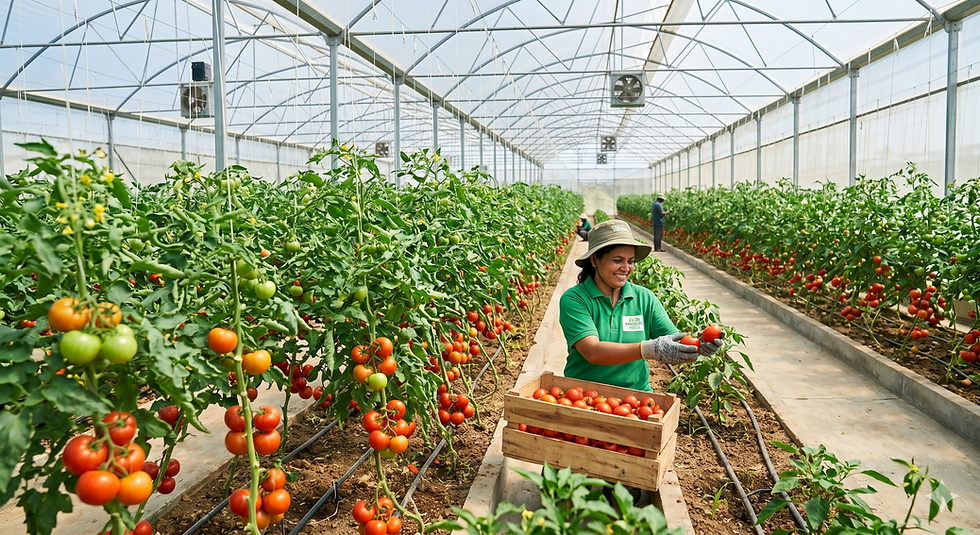
Polyhouse farming is a form of protected cultivation where crops are grown inside a specially designed structure covered with UV-stabilized polyethylene (plastic) sheets. This structure — called a polyhouse — creates a controlled micro-environment inside, shielding plants from harsh external conditions like excessive heat, cold, rain, wind, and pests.
Think of it like building a protective bubble for your crops. The plastic cover acts like a greenhouse, trapping heat during winters and blocking harmful UV rays in summers. Depending on the sophistication of the polyhouse, farmers can control temperature, humidity, light intensity, CO2 levels, and irrigation — all from within one structure.
Key Components of a Polyhouse Structure
Frame: Made of GI (galvanized iron) pipes or tubular steel for strength and durability
Covering: UV-stabilized polyethylene film (200 micron thickness is most common in India)
Foundation: Concrete or grouted pipe anchors to withstand wind load
Ventilation: Side and roof vents, or mechanical fans for climate-controlled structures
Irrigation: Drip irrigation with fertigation units for precise water and nutrient delivery
In simple terms: A polyhouse is a modern farming structure that lets you control your crop's environment, protect it from outside threats, and grow it year-round for better yields and profits.
Polyhouse Farming in India: The Big Picture
India is the second largest producer of fruits and vegetables in the world, yet post-harvest losses remain as high as 30–40% due to weather damage, pest attacks, and poor quality control. Polyhouse farming directly addresses many of these problems.
Why Polyhouse Farming Matters for Indian Farmers
India's climate is highly variable — from floods in Assam to droughts in Rajasthan. Polyhouses provide a stable growing environment regardless of region.
With water tables falling and droughts becoming more frequent, drip-based polyhouse farming saves up to 50% water compared to open-field cultivation.
Export demand for Indian vegetables and cut flowers (especially to UAE, Europe, and Japan) requires consistent quality — something only protected cultivation can guarantee.
Urban demand for off-season vegetables is growing rapidly. Polyhouse farmers can supply tomatoes, capsicum, and cucumbers year-round at premium prices.
States Where Polyhouse Farming is Thriving
Polyhouse farming is practiced across India, but certain states lead in adoption:
State | Key Crops | Known For |
Maharashtra | Tomato, Capsicum, Rose, Gerbera | Export-quality floriculture |
Karnataka | Rose, Carnation, Cucumber | Cut flower exports to Europe |
Haryana | Tomato, Cucumber, Capsicum | Vegetable supply to Delhi NCR |
Himachal Pradesh | Cherry Tomato, Herbs, Strawberry | High-altitude protected farming |
Rajasthan | Capsicum, Cucumber, Gerbera | Subsidy-driven growth |
Gujarat | Tomato, Paprika, Flowers | Agri-export hub |
Government Support for Polyhouse Farming
The Indian government actively promotes polyhouse farming through multiple schemes under the National Horticulture Mission (NHM) and Mission for Integrated Development of Horticulture (MIDH). Subsidies range from 50% to 65% of the total project cost, depending on the state, category of farmer, and type of structure.
Types of Polyhouse Structures in India
Not all polyhouses are the same. Depending on your budget, crop, and location, you can choose from three main types:
A. Naturally Ventilated Polyhouse (NVPH)
This is the most common type in India. It uses the natural flow of air through side and roof vents to regulate temperature and humidity. No mechanical systems are required, making it cost-effective.
Best for: Vegetables like tomato, capsicum, cucumber; also suitable for nursery production
Cost range: Rs. 700 – Rs. 1,200 per sq. meter
Ideal for: Most plains and hilly regions of India
B. Climate-Controlled Polyhouse (Fan & Pad System)
This is a high-tech polyhouse with automated cooling pads, fans, heaters, humidity controllers, and CO2 enrichment systems. The environment is fully controlled using sensors and automation.
Best for: Cut flowers (rose, gerbera, carnation), exotic herbs, high-value export crops
Cost range: Rs. 2,000 – Rs. 4,000 per sq. meter
Ideal for: Regions with extreme summer or winter temperatures
C. Walk-in Tunnel / Low-Cost Polyhouse
A low-cost, simple structure made of bamboo or mild steel hoops covered with polythene film. This is a good entry point for beginners or small farmers testing polyhouse farming for the first time.
Best for: Short-duration crops like leafy vegetables, nursery plants, seedling production
Cost range: Rs. 150 – Rs. 400 per sq. meter
Ideal for: Small farmers with limited budget; hilly and tribal areas
Benefits of Polyhouse Farming
Polyhouse farming offers a long list of advantages over traditional open-field cultivation. Here are the most important ones:
Higher Yield: Polyhouse crops can yield 3 to 5 times more than open-field crops of the same variety. For example, tomato yield in a polyhouse can reach 150–200 tonnes/acre vs. 30–40 tonnes/acre in open fields.
Year-Round Farming: Grow any crop in any season. Off-season vegetables command 2–3x higher market prices, significantly boosting your income.
Better Crop Quality: Controlled environment reduces blemishes, ensures uniform size, and improves shelf life — important for export and retail markets.
Water Saving: Drip irrigation inside the polyhouse saves 40–50% water compared to flood irrigation. Fertigation (fertilizer + irrigation combined) also reduces fertilizer waste.
Pest & Disease Control: The physical barrier of the polyhouse significantly reduces pest entry. This means lower pesticide use, safer produce, and lower input costs.
Weather Protection: Hailstorms, unseasonal rains, frost, and strong winds cannot damage your crop when it is inside a polyhouse.
Reduced Post-Harvest Loss: Better quality and uniformity means less rejection, lower wastage, and better price realization.
Polyhouse Farming Cost in India: A Detailed Breakdown
One of the first questions every farmer asks is: How much does it cost to build a polyhouse? The answer depends on the type of structure, your location, the crop you want to grow, and available subsidies.
Here is a detailed cost estimate for a 1,000 sq. meter (approx. 0.25 acre) Naturally Ventilated Polyhouse — the most common choice for vegetable farming in India:
Cost Component | Approx. Cost (Rs.) | Notes |
GI Structure + Foundation | 5,00,000 – 7,00,000 | Per 1,000 sq. m. (NVPH) |
UV Polyethylene Film Cover | 1,00,000 – 1,50,000 | 200 micron, lasts 4–5 years |
Drip Irrigation + Fertigation Unit | 80,000 – 1,20,000 | Depends on automation level |
Growing Media / Coco Peat | 50,000 – 80,000 | For soilless/substrate growing |
Planting Material (Seeds/Grafted Saplings) | 40,000 – 1,00,000 | Varies by crop |
Labour (Setup + Planting) | 30,000 – 50,000 | Seasonal workers |
Miscellaneous (wires, clips, tools) | 20,000 – 40,000 | One-time cost |
Total Estimated Cost | Rs. 8.2 – 12 Lakhs | For 1,000 sq. m. NVPH |
Important: After government subsidy (50–65%), your actual investment may come down to just Rs. 3–6 lakhs for a 1,000 sq. m. polyhouse. For high-tech climate-controlled structures, costs can go up to Rs. 30–40 lakhs per 1,000 sq. m. before subsidy.
Polyhouse Subsidy in India: Government Schemes You Should Know
The Indian government heavily subsidizes polyhouse farming to encourage adoption of protected cultivation technologies. Here is a summary of the key schemes:
National Horticulture Mission (NHM) / MIDH
Subsidy: 50% of the cost for general farmers; 65–75% for small, marginal, or SC/ST farmers
Applicable for: Naturally ventilated and climate-controlled polyhouses, shade nets, plastic mulch
Who can apply: Any Indian farmer with land ownership documents, Aadhaar card, and bank account
State-Specific Schemes
Maharashtra: MSAMB and Mahagrapes offer additional subsidies for export-linked polyhouse projects.
Karnataka: Department of Horticulture provides separate state-level subsidies on top of NHM.
Rajasthan: Special provisions for tribal and desert region farmers under RKVY.
UP & Bihar: ATMA (Agricultural Technology Management Agency) supports demonstration and pilot polyhouses.
How to Apply for Polyhouse Subsidy
Contact your District Horticulture Officer (DHO) or Block Development Officer (BDO).
Submit your application with land documents, Aadhaar, bank passbook, and project plan.
Get the site inspected and the project sanctioned before starting construction.
After construction is verified, subsidy is transferred directly to your bank account via DBT.
Farmer Tip: Never start building before getting the sanction letter. If you build the polyhouse first and apply for subsidy later, your application may be rejected in most states.
Best Crops for Polyhouse Farming in India
Choosing the right crop is the most important decision for polyhouse profitability. Here are the best options, organized by category:
Crop | Type | Yield (per acre) | Market Price Range |
Capsicum (Bell Pepper) | Vegetable | 20–25 tonnes | Rs. 30–100/kg |
Cherry Tomato | Vegetable | 15–20 tonnes | Rs. 60–120/kg |
Cucumber (Euro variety) | Vegetable | 25–35 tonnes | Rs. 25–60/kg |
Dutch Rose | Flower | 1.5–2 lakh stems | Rs. 5–20/stem |
Gerbera | Flower | 1.5–2.5 lakh stems | Rs. 3–12/stem |
Carnation | Flower | 1–2 lakh stems | Rs. 4–15/stem |
Lettuce / Microgreens | Herb / Exotic | 8–12 tonnes | Rs. 80–200/kg |
Strawberry | Fruit | 12–18 tonnes | Rs. 80–250/kg |
Expert Insight: For beginners, capsicum (bell pepper) is one of the safest and most profitable crops to start with in a naturally ventilated polyhouse. It has a long harvest period (6–8 months), strong domestic demand, and good export potential.
How to Start Polyhouse Farming in India: Step-by-Step
Step 1 – Plan and Feasibility
Before anything else, decide your crop, assess your land, and understand the local market. Visit existing polyhouses in your region to get a ground-level understanding.
Step 2 – Apply for Subsidy
Apply at your District Horticulture Office before construction. Get a site inspection done and collect the official sanction letter. This step can take 30–90 days depending on your state.
Step 3 – Select a Good Contractor
Choose a polyhouse structure contractor who has completed at least 10–15 projects. Ask for references, check their past work, and get a written contract specifying material specifications (GI pipe grade, micron of film, etc.).
Step 4 – Install Irrigation & Fertigation System
A well-designed drip irrigation system is essential. Make sure the system includes pressure-compensating drippers, filtration unit, and a venturi or EC/pH-based fertigation controller.
Step 5 – Soil Preparation or Media Filling
For soil-based cultivation, prepare raised beds with FYM, compost, and sand. For soilless farming, fill grow bags with coco peat + perlite (80:20) mix.
Step 6 – Crop Selection and Planting
Use hybrid, disease-resistant seeds or grafted saplings. Source from reputed companies like Syngenta, East-West Seeds, Nunhems, or Indo-American Hybrid Seeds.
Step 7 – Ongoing Crop Management
Maintain temperature between 18–28°C for most vegetable crops
Monitor and manage humidity (60–80% RH is ideal for most crops)
Regular pruning, training, and staking for vertical crops like tomato and capsicum
Integrated Pest Management (IPM) — yellow sticky traps, neem oil sprays, biological agents
Fertigation scheduling based on crop growth stage
Challenges in Polyhouse Farming (And How to Overcome Them)
High Initial Investment: Even with subsidies, the upfront cost is significant. Solution: Start with a smaller structure (500–1,000 sq. m.) to learn before scaling up.
Technical Knowledge Required: Polyhouse farming is not like traditional farming. Farmers need training in climate management, fertigation, and IPM. Solution: Attend KVK (Krishi Vigyan Kendra) training programs and state horticulture department workshops.
Maintenance Costs: UV film needs replacement every 4–5 years. Drip lines and filters need regular cleaning. Budget Rs. 50,000–1,00,000 per year for maintenance.
Market Linkage: Producing good quality is only half the job — you also need reliable buyers. Solution: Tie up with APMC mandis, retail chains, or vegetable exporters before harvesting.
Pest Control Inside Polyhouse: Thrips, whiteflies, and spider mites can still be problematic inside. Use sticky traps, screen barriers, and biological control agents regularly.
Polyhouse vs. Greenhouse Farming: What's the Difference?
Many people use these terms interchangeably, but there are some practical differences — especially in the Indian context:
Feature | Polyhouse | Greenhouse (Glass) |
Covering Material | UV Polyethylene Film | Glass or Polycarbonate Panels |
Cost | Lower (Rs. 700–4,000/sq.m.) | Higher (Rs. 3,000–10,000/sq.m.) |
Durability | 4–8 years (film life) | 20–30+ years |
Climate Control | Partial to Full | Full |
Common in India | Very Common | Limited (mostly research) |
Subsidy Availability | Yes (NHM, MIDH) | Limited or project-specific |
In India, polyhouse farming is far more popular and practical than glass greenhouse farming due to lower costs and government support. For most Indian farmers, a naturally ventilated or fan-and-pad polyhouse is the most suitable choice.
Profit Potential of Polyhouse Farming: Real-World Numbers
Case Example: Capsicum in 1,000 sq. m. NVPH (After Subsidy)
Total Investment (after 50% subsidy): Approx. Rs. 4–5 Lakhs
Annual Yield: 8,000–10,000 kg of capsicum
Average Sale Price: Rs. 50–80 per kg (off-season premium)
Gross Revenue: Rs. 4–8 Lakhs per crop cycle (6–8 months)
Operating Costs (labour, fertilizer, pesticide, water): Rs. 1.5–2.5 Lakhs
Net Profit: Rs. 2–5 Lakhs per crop cycle
ROI Timeline: Most polyhouse farmers recover their investment within 2–3 crop cycles (approximately 2–3 years) for vegetable crops, and 3–5 years for floriculture projects.
Important Note: Profitability depends heavily on crop selection, market linkage, management skills, and local climate conditions. These are indicative figures — actual results may vary.
Conclusion: Is Polyhouse Farming Right for You?
Polyhouse farming in India is not just a trend — it is a necessity for the future of Indian agriculture. With land holdings shrinking, weather patterns becoming increasingly erratic, and consumer demand for quality produce rising, protected cultivation offers a practical, scalable, and profitable path forward for Indian farmers.
Whether you are a small farmer in Vidarbha looking to secure your income, or an agri-entrepreneur in Bengaluru looking to start a cut flower export venture, polyhouse farming has something to offer you.
The combination of government subsidies (up to 65%), rising demand for high-value crops, and improving technology has made polyhouse farming more accessible than ever. The key is to start informed, plan carefully, and never skip the subsidy application before you build.
Take the first step today: Visit your District Horticulture Office, attend a KVK training, and connect with a farmer already doing polyhouse farming in your region. The investment is high, but so is the reward.
Frequently Asked Questions (FAQs)
What is polyhouse farming?
Polyhouse farming is a type of protected cultivation where crops are grown inside a structure covered with UV-stabilized polyethylene (plastic) film. The structure controls temperature, humidity, and light to create an ideal growing environment for plants throughout the year.
How much does polyhouse farming cost in India?
The cost of a naturally ventilated polyhouse in India ranges from Rs. 700 to Rs. 1,200 per sq. meter. For a 1,000 sq. meter structure, total investment (including irrigation, planting material, and setup) is approximately Rs. 8–12 lakhs before subsidy. After government subsidy of 50–65%, the net cost can come down to Rs. 3–6 lakhs.
Is polyhouse farming profitable in India?
Yes, polyhouse farming can be highly profitable when done with proper planning. For crops like capsicum, cherry tomato, or Dutch rose, net profits of Rs. 2–5 lakhs per crop cycle from a 1,000 sq. m. polyhouse are achievable. Most farmers recover their investment within 2–3 years.
What crops are best for polyhouse farming in India?
The most profitable crops for polyhouse farming in India include capsicum (bell pepper), cherry tomato, cucumber, Dutch rose, gerbera, carnation, strawberry, and lettuce/microgreens. For beginners, capsicum or cucumber in a naturally ventilated polyhouse is the recommended starting point.
How much subsidy is available for polyhouse farming in India?
Under the National Horticulture Mission (NHM) and MIDH (Mission for Integrated Development of Horticulture), the central and state governments provide 50% subsidy for general category farmers and 65–75% for small, marginal, SC/ST, and women farmers. The exact amount varies by state.
What is the difference between a polyhouse and a greenhouse?
A polyhouse uses UV polyethylene plastic film as its covering material, while a traditional greenhouse uses glass or polycarbonate panels. Polyhouses are much more affordable (Rs. 700–4,000/sq. m. vs. Rs. 3,000–10,000/sq. m. for glass), making them the preferred choice for Indian farmers. Government subsidies are also more readily available for polyhouses.
How long does a polyhouse last?
A well-constructed GI pipe polyhouse structure can last 15–20 years or more. The UV polyethylene film covering, however, needs to be replaced every 4–5 years. The drip irrigation system typically lasts 8–12 years with proper maintenance.
Can small farmers afford polyhouse farming?
Yes! With government subsidies of up to 65%, small farmers can set up a 500 sq. meter polyhouse for as little as Rs. 1.5–3 lakhs in many states. Low-cost walk-in tunnel structures are available for even lower budgets (Rs. 75,000–2 lakhs for 500 sq. m.). Many state governments also provide bank linkage and loan facilitation for polyhouse projects.


Comments