.png)


Capsicum Farming in Polyhouse: Complete Guide for Indian Farmers

Updated: May 8
Why Capsicum Farming in Polyhouse is a Smart Choice
Walk into any supermarket in Delhi, Pune, or Bengaluru today and you will find colourful red, yellow, and green capsicums (bell peppers) selling at Rs. 60 to Rs. 200 per kilogram. Now imagine growing these in your own polyhouse — with 3 to 5 times higher yield, better quality, and year-round production.
Capsicum farming in polyhouse is one of the most profitable forms of protected cultivation in India today. With rising consumer demand for capsicum in hotels, restaurants, salad bars, and households, the market is consistently strong — and it only grows bigger every year.
Indian farmers in states like Haryana, Maharashtra, Karnataka, Rajasthan, and Himachal Pradesh have already made crores of rupees from polyhouse capsicum cultivation. The combination of government subsidies, drip irrigation, and modern hybrid varieties has made it possible even for small and medium farmers to succeed.
This complete guide covers everything you need to know — from soil preparation and nursery to fertigation, pest control, cost breakdown, expected profit, and government subsidies — all written specifically for Indian farming conditions.
What is Capsicum Farming in Polyhouse?
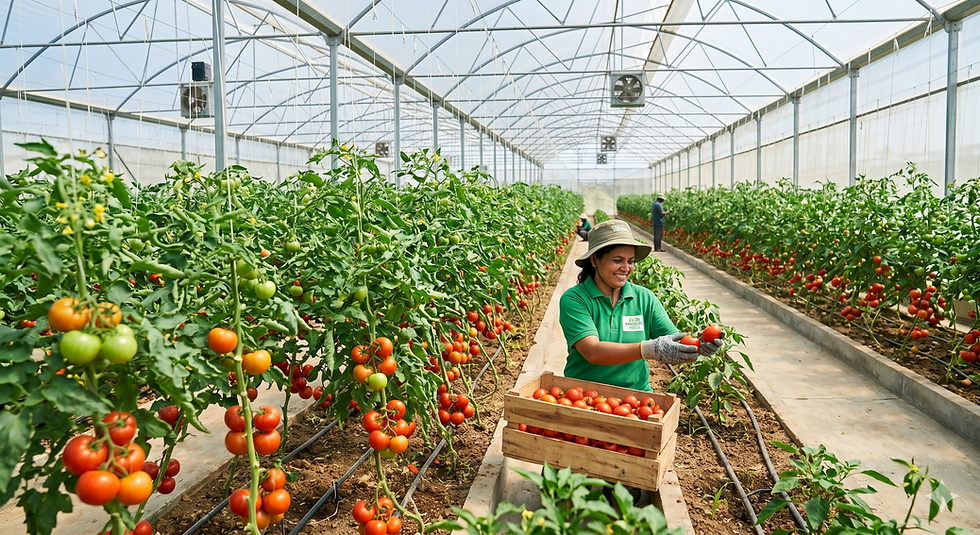
Capsicum farming in polyhouse means growing bell peppers (Shimla mirch) inside a structure covered with UV-stabilized polyethylene film. This protected environment shields the crop from harsh weather, pest pressure, and temperature fluctuations that commonly damage open-field capsicum.
In open fields, capsicum is highly sensitive to temperature extremes, rain, and wind. Even a single hailstorm can destroy an entire crop. Inside a polyhouse, the farmer controls the environment — and the crop responds with dramatically higher yield and quality.
How Polyhouse Helps Capsicum Specifically
Capsicum needs a very specific temperature range (22–28°C). A polyhouse maintains this precisely.
Bell peppers are highly attractive to thrips and aphids. The polyhouse film acts as a first line of defence.
Capsicum plants need consistent moisture. Drip irrigation inside the polyhouse ensures roots are never stressed.
The controlled environment produces uniform, blemish-free fruits — which command premium prices in retail and export markets.
Why Choose Capsicum for Polyhouse Farming in India?
High Market Demand: Capsicum is in continuous demand from hotels, restaurants, fast-food chains, and modern retail throughout the year.
Premium Pricing: Coloured capsicum (red, yellow) sells at Rs. 80–200/kg in metros — 3 to 4 times higher than most vegetables.
Long Harvest Window: A single crop cycle lasts 7–8 months inside a polyhouse, giving multiple harvests from the same planting.
Year-Round Production: Unlike open-field capsicum (which is seasonal), polyhouse production is not limited by season.
Export Potential: Indian capsicum is exported to UAE, Singapore, UK, and other countries. Polyhouse-grown capsicum meets export quality standards more easily.
Subsidy Support: Both polyhouse structure and capsicum as a high-value vegetable crop are supported under government schemes.
Climate & Temperature Requirements for Capsicum
Capsicum is a warm-season crop, but it does not tolerate extremes. This is exactly why open-field capsicum struggles in many parts of India — and polyhouse cultivation solves this problem.
Parameter | Ideal Range | What Happens if Not Met |
Day Temperature | 22°C – 28°C | Flower drop at >32°C or <15°C |
Night Temperature | 16°C – 20°C | Poor fruit set below 12°C |
Relative Humidity | 60% – 75% | Fungal diseases above 85% |
Light (PAR) | High diffused light | Low light reduces fruit colour |
CO2 Level | 400–800 ppm | Higher CO2 improves yield |
Farmer Tip: In hot summer months (April–June), use shade net (30–50%) inside the polyhouse on the roof to reduce temperature by 3–5°C and prevent flower drop.
Soil Requirements for Polyhouse Capsicum Cultivation
Capsicum can be grown in soil or in soilless media (cocopeat + perlite) inside a polyhouse. Here is what you need to know:
For Soil-Based Growing
Best Soil Type: Well-drained loamy or sandy loam soil. Avoid heavy clay soil — it retains excess water and causes root rot.
pH Range: 6.0 – 6.8 (slightly acidic to neutral). Get a soil test done before planting.
Organic Matter: Add 20–30 tonnes of well-decomposed farmyard manure (FYM) or compost per acre before bed preparation.
Drainage: Capsicum roots cannot tolerate waterlogging even for a few hours. Raise beds 15–20 cm above the walkway.
For Soilless Growing (Cocopeat Bags)
Many advanced polyhouse farmers now grow capsicum in coco peat + perlite grow bags (80:20 ratio). This method eliminates soil-borne diseases, allows precise nutrient control, and is reusable for 2–3 years.
Grow Bag Size: 35–40 cm diameter bags, 20–25 litre capacity
Media Cost: Rs. 50,000–80,000 per 1,000 sq. m. (one-time, reusable)
Popular Capsicum Varieties for Polyhouse Farming in India
Choosing the right variety is critical. For polyhouse capsicum cultivation, always use F1 hybrid varieties bred specifically for protected cultivation. Open-pollinated or field varieties will underperform in a polyhouse.
Variety | Colour | Company | Avg. Yield | Best For |
Inspiration | Red | Syngenta | 10–12 kg/plant | Export + domestic |
Bachata | Yellow | Syngenta | 9–11 kg/plant | Premium domestic markets |
Bomby | Green | De Ruiter (Monsanto) | 8–10 kg/plant | HoReCa + retail |
Indam Shweta | Green/Yellow | Indo-American | 8–10 kg/plant | Affordable entry-level |
SV 0453 CP | Red | Seminis | 10–13 kg/plant | Export quality |
Celica | Yellow | Rijk Zwaan | 9–11 kg/plant | Premium retail |
Farmer Insight: Red and yellow capsicum consistently command 30–50% higher prices than green capsicum. If your market has good cold-chain or export access, go for red/yellow hybrid varieties.
Polyhouse Setup for Capsicum Farming
Recommended Structure Type
For capsicum farming, a Naturally Ventilated Polyhouse (NVPH) with side and roof vents is the most practical and cost-effective option in India. In hot regions (Rajasthan, Gujarat, parts of Maharashtra), a fan-and-pad cooling system gives better results during peak summer.
Bed Preparation Inside the Polyhouse
Mark two raised beds per bay (each bay is typically 8–9 metres wide).
Bed size: 90–100 cm wide, 20–25 cm high, with 60 cm walkway between beds.
Fill beds with soil + FYM + compost (or use coco peat grow bags).
Apply basal dose of fertilizer: single superphosphate (SSP) + potash before planting.
Sterilize soil with formaldehyde (dazomet granules) or steam if soil-borne disease history exists.
Mulching
Always use black or silver-black plastic mulch (25–30 micron) on the raised beds. Mulch conserves moisture, suppresses weeds, prevents soil splashing (which spreads fungal diseases), and maintains root zone temperature.
Drip Irrigation System
Install a drip irrigation system with inline drippers spaced 30 cm apart. Drip emitter discharge rate: 2–4 litres per hour. Connect the drip system to a fertigation unit (venturi injector or EC/pH controller for precision feeding).
Step-by-Step Capsicum Cultivation Process
Step 1 – Nursery Preparation
Do not transplant direct-seeded seedlings — always raise nursery in Pro-trays (98 or 72 cell trays) filled with coco peat.
Sow seeds in pro-trays, 1 seed per cell, at 0.5 cm depth.
Maintain temperature of 25–28°C in a shaded nursery area.
Germination occurs in 7–10 days.
Seedlings are ready for transplanting in 30–35 days (4–5 true leaves stage).
Tip: Always buy seeds treated with fungicide coating (Thiram or Captan) for better germination and disease-free seedlings. Treated seeds appear reddish or blue in colour.
Step 2 – Transplanting
Best time: Early morning or late evening to avoid transplant stress.
Water the beds thoroughly 12 hours before transplanting.
Transplant carefully without disturbing the root ball.
Plant depth: Up to the first true leaf node.
Give light irrigation immediately after transplanting.
Step 3 – Spacing
Proper spacing ensures good air circulation, reduces disease pressure, and maximizes light interception for each plant.
Row Spacing | Plant Spacing | Plants per 1,000 sq. m. | System |
60 cm | 45 cm | 2,200 – 2,500 plants | Single stem training |
60 cm | 30 cm | 3,000 – 3,300 plants | Double stem training |
90 cm | 30 cm | 2,400 – 2,600 plants | Triple stem / open system |
Farmer Insight: The double-stem training method at 60 x 30 cm is most widely used in India for high-yield polyhouse capsicum. It gives good balance between plant density and fruit size.
Step 4 – Irrigation Schedule
Week 1–2 (after transplanting): Light irrigation, 1–2 times per day for 5–10 minutes.
Vegetative stage (Week 3–8): Increase to 15–20 minutes, 2–3 times per day depending on temperature.
Flowering to fruit setting: Consistent moisture critical — never let the root zone dry out.
Fruiting stage: High water demand — 25–35 litres per plant per week in peak summer.
Step 5 – Fertigation (Feeding Through Drip)
Capsicum is a heavy feeder. Fertigation (mixing water-soluble fertilizers in drip water) is the most efficient and effective method of feeding the crop.
Growth Stage | Key Nutrients | Target EC (mS/cm) | Duration |
Vegetative (0–45 days) | N:P:K = 20:20:20 + calcium | 1.5 – 2.0 | Daily |
Flowering (45–75 days) | N:P:K = 12:6:40 + boron | 2.0 – 2.5 | Daily |
Fruiting (75–210 days) | N:P:K = 13:0:46 + calcium nitrate | 2.5 – 3.0 | Daily |
Colour Change (final) | Potassium sulphate heavy | 2.5 – 3.0 | Daily |
Important: Never use soil-applied urea or DAP inside a polyhouse with drip irrigation. Always use fully water-soluble grade fertilisers (19:19:19, 13:0:46, calcium nitrate, etc.) to prevent dripper clogging.
Step 6 – Training & Pruning
This is the most labour-intensive but critically important part of polyhouse capsicum management:
Primary Pruning: Remove all shoots below the first fork (bifurcation point). Keep 2 main stems per plant (for double-stem system).
String Training: Attach each stem to a vertical string or wire above. As the plant grows, twist the stem around the string weekly.
Leaf Pruning: Remove old, yellowing leaves from the bottom of the plant every 2–3 weeks. This improves air circulation and reduces disease.
Height Management: When plants reach the wire (2.5–3 m height), lower the strings and let stems trail sideways — this is called 'lowering and leaning'.
Step 7 – Pollination
Unlike open fields, polyhouses have limited natural pollination. To ensure good fruit set, especially for coloured varieties:
Shake the string or wire gently every 2–3 days to release pollen from open flowers (vibration pollination).
Use a handheld electric pollinator (vibrating wand) for large polyhouses — it mimics bee vibrations.
Introduce bumblebee hives (Apis mellifera or Bombus spp.) inside larger polyhouses for natural pollination. This significantly improves fruit size and yield.
Pest and Disease Management in Polyhouse Capsicum
Common Pests
Pest | Symptoms | Control Method |
Thrips | Silvery streaks on leaves, flower drop | Yellow sticky traps + Spinosad spray |
Aphids | Curled leaves, honeydew, black sooty mould | Neem oil 5 ml/L + Imidacloprid |
Spider Mites | Fine webbing, bronze/rusty leaves | Abamectin + wettable sulphur |
Whitefly | Yellowing leaves, sticky honeydew | Blue sticky traps + Pyriproxyfen spray |
Common Diseases
Disease | Symptoms | Control Method |
Damping Off (nursery) | Seedling collapse at soil level | Trichoderma + Captan drench |
Powdery Mildew | White powder on leaves, stems | Wettable sulphur / Myclobutanil spray |
Fusarium Wilt | Wilting despite moisture, brown stem inside | Carbendazim drench + crop rotation |
Bacterial Spot | Water-soaked leaf spots turning brown | Copper oxychloride + Streptomycin |
Botrytis (Grey Mould) | Grey fuzzy patches on fruit/stem | Reduce humidity + Iprodione spray |
IPM Tip: Prevention is always better than cure in a polyhouse. Install 50-mesh insect-proof net at all vents and entry points. This alone can reduce pest incidence by 60–70% without any pesticide.
Capsicum Farming Cost in Polyhouse (India) — Detailed Breakdown
Here is a realistic cost estimate for growing capsicum in a 1,000 sq. meter naturally ventilated polyhouse. These are indicative figures based on current market rates (2024–25) and will vary by state and input availability.
A. One-Time / Infrastructure Cost (Amortized over 5 years)
Item | Cost (Rs.) | Remarks |
NVPH Structure (GI pipe + film) | 7,00,000 – 9,00,000 | Film life 4–5 years; structure 15+ years |
Drip Irrigation + Fertigation Unit | 80,000 – 1,20,000 | Including filters, header, drippers |
Mulching Film | 25,000 – 35,000 | Per crop cycle |
Grow Media / Bed Preparation | 30,000 – 60,000 | FYM, coco peat, soil amendments |
Insect Proof Net + Training Wires | 40,000 – 60,000 | One-time |
Total Infrastructure | ~Rs. 9 – 12 Lakhs | Before subsidy |
After 50% Subsidy (NHM/MIDH) | ~Rs. 4.5 – 6 Lakhs | Net farmer investment |
B. Per Crop Cycle Operating Costs (1,000 sq. m.)
Item | Cost (Rs.) | Notes |
Capsicum Seeds (hybrid F1) | 15,000 – 25,000 | 2,500 seeds approx. at Rs. 6–10/seed |
Nursery Raising Cost | 10,000 – 15,000 | Pro-trays, coco peat, labour |
Fertilizers & Micronutrients | 40,000 – 60,000 | Water-soluble grades for 7 months |
Pesticides & Fungicides | 20,000 – 35,000 | IPM-based; can reduce with bio-agents |
Labour (planting to harvest) | 60,000 – 90,000 | Pruning, harvesting, grading — 7 months |
Electricity (irrigation pump) | 10,000 – 20,000 | Depends on water source & pump size |
Packaging & Transport | 15,000 – 25,000 | Crates, cartons, freight to market |
Miscellaneous | 10,000 – 15,000 | Repairs, tools, contingency |
Total Operating Cost | Rs. 1.8 – 2.85 Lakhs | Per crop cycle (7–8 months) |
Cost Note: Labour is often the highest variable cost in polyhouse capsicum farming. Many successful farmers reduce this by training family members and hiring skilled agricultural workers on a season basis rather than daily wages.
Capsicum Yield in Polyhouse — What to Realistically Expect
Parameter | Polyhouse Capsicum | Open Field Capsicum |
Yield per Plant | 8 – 13 kg per plant | 2 – 4 kg per plant |
Yield per 1,000 sq. m. | 20,000 – 30,000 kg | 5,000 – 8,000 kg |
Yield per Acre | 80,000 – 1,20,000 kg* | 20,000 – 35,000 kg |
Crop Duration | 7 – 8 months | 3 – 4 months |
Fruit Quality Grade | Export + Premium Retail | Local Market Grade |
Harvest Frequency | Every 5–7 days | Every 7–10 days |
*Note: Yield per acre from polyhouse depends on the total polyhouse area per acre of land. A single 1,000 sq. m. polyhouse typically achieves 20,000–30,000 kg per crop cycle.
Real Example: A farmer in Nashik, Maharashtra running two polyhouses of 1,000 sq. m. each produced 52,000 kg of red capsicum in one crop cycle (7 months) using Inspiration variety by Syngenta. He sold at an average Rs. 75/kg to a Pune exporter, earning Rs. 39 lakhs gross revenue.
Profit & Return on Investment (ROI) from Polyhouse Capsicum
Income Estimate — 1,000 sq. m. Polyhouse (One Crop Cycle)
Item | Conservative | Optimistic |
Total Yield | 20,000 kg | 28,000 kg |
Average Sale Price | Rs. 40/kg | Rs. 70/kg |
Gross Revenue | Rs. 8,00,000 | Rs. 19,60,000 |
Operating Cost | Rs. 2,85,000 | Rs. 2,85,000 |
Net Profit (per cycle) | Rs. 5,15,000 | Rs. 16,75,000 |
Crop Cycles per Year | 1.2 (with 1 short cycle) | 1.5 (with rotation) |
Payback Period: Most polyhouse capsicum farmers recover their net investment (after subsidy) within 1.5 to 2.5 crop cycles — approximately 18 to 30 months.
Price Range to Know: Green capsicum: Rs. 30–80/kg; Yellow capsicum: Rs. 60–150/kg; Red capsicum: Rs. 70–180/kg. Prices peak in October–December and May–July (off-season supply periods).
Government Subsidy for Polyhouse Capsicum Farming in India
National Horticulture Mission (NHM) / MIDH
Subsidy for Polyhouse Structure: 50% for general farmers; 65–75% for small, marginal, SC/ST, and women farmers
Maximum Project Size Covered: 4,000 sq. m. per beneficiary under NHM (state-wise limits may differ)
Covered Components: Structure + film + drip irrigation + grow media (crop itself is not subsidized separately)
Other Relevant Schemes
PM-KUSUM: Solar pump subsidy for irrigation electricity cost reduction (up to 90% in some states).
RKVY (Rashtriya Krishi Vikas Yojana): Additional state-level grants for innovative farming projects including polyhouse.
NABARD Financing: Provides term loans for polyhouse projects at subsidized interest rates (3–7% through Kisan Credit Card or allied schemes).
How to Apply — Quick Steps
Approach your District Horticulture Officer (DHO) with land records and Aadhaar.
Submit your project plan, get site inspection done, and wait for the sanction letter.
Only start construction after getting written approval.
After completion and verification, subsidy is credited via DBT to your bank account.
Warning: NEVER build the polyhouse before getting the sanction letter. In most states, construction before official approval disqualifies you from subsidy entirely.
Key Advantages of Capsicum Farming in Polyhouse
3–5x Higher Yield: Compared to open-field cultivation, polyhouse capsicum delivers dramatically more per unit area.
Premium Quality Produce: Uniform size, smooth skin, bright colour — meeting retail and export quality standards that open-field crops rarely achieve.
Year-Round Production: No seasonal limitations. Grow and sell when prices are highest.
Reduced Water Use: Drip irrigation saves 40–50% water vs. flood irrigation, critical in water-scarce regions.
Lower Pesticide Dependency: Insect-proof netting and physical barriers drastically reduce spray frequency and cost.
Export Potential: Polyhouse-grown capsicum meets the quality and residue standards required for export to Europe, Gulf, and Southeast Asia.
Challenges in Polyhouse Capsicum Farming
High Initial Investment: Even with subsidies, Rs. 4–6 lakhs is a significant amount for small farmers. Solution: Start with 500 sq. m., learn the system, then scale up.
Skilled Labour Requirement: Training, pruning, and fertigation need skilled workers. Solution: Attend KVK trainings; many state horticulture departments offer free hands-on programs.
Disease Pressure in Humid Conditions: Powdery mildew and Botrytis can spread quickly in closed environments. Solution: Maintain 60–75% RH; ensure proper ventilation.
Market Price Volatility: Capsicum prices can fluctuate Rs. 20–180/kg depending on season and supply. Solution: Tie up with institutional buyers, exporters, or retail chains for stable pricing.
Maintenance Costs: UV film needs replacement every 4–5 years (Rs. 1–1.5 lakhs per 1,000 sq. m.). Budget for this from year one.
Practical Tips for Successful Capsicum Polyhouse Farming
Visit first, invest later: Before setting up your own polyhouse, visit at least 3–5 successful capsicum polyhouse farms in your region. Ask farmers what went wrong and what they would do differently.
Never skip soil testing: A simple Rs. 500 soil test can save you lakhs in fertilizer waste and crop failure.
Source verified seeds: Always buy seeds from authorised dealers of reputed companies (Syngenta, Rijk Zwaan, Seminis). Counterfeit seeds are common and costly.
Keep a crop diary: Record daily temperature, humidity, irrigation duration, fertilizer dose, and spray records. This helps you diagnose problems faster.
Build market ties before you harvest: Contact exporters, hotel procurement managers, or APMC traders before your crop is ready. Waiting to sell after harvest means lower bargaining power.
Hire a polyhouse agronomist for the first season: A consultant who visits your polyhouse every 15 days (cost: Rs. 5,000–10,000/month) can save you from costly mistakes in the first cycle.
Avoid overwatering: More capsicum crops are killed by over-irrigation than under-irrigation inside polyhouses. Install tensiometers or soil moisture sensors if possible.
Conclusion: Is Polyhouse Capsicum Farming Right for You?
Capsicum farming in polyhouse is one of the best decisions an Indian farmer can make today. With strong and growing market demand, premium pricing for coloured varieties, government subsidies reducing the investment barrier, and a proven track record of profitability across multiple states — this is a crop and a system that delivers results.
The challenges are real — high initial cost, need for skill, and market price volatility — but they are all manageable with the right planning, training, and market linkage. Thousands of farmers across Maharashtra, Karnataka, Haryana, and Rajasthan are living proof that polyhouse capsicum can transform a farming family's income.
Your next step: Contact your District Horticulture Office for subsidy information, visit a nearby polyhouse capsicum farmer, and start with a 500–1,000 sq. meter trial. The investment is significant, but the payback is real.
Frequently Asked Questions (FAQs)
What is capsicum farming in polyhouse?
Capsicum farming in polyhouse means growing bell peppers (Shimla mirch) inside a UV-polyethylene covered structure that protects the crop from weather, pests, and temperature extremes. The controlled environment allows year-round production with significantly higher yield and better fruit quality than open-field farming.
How much does it cost to do capsicum farming in a polyhouse?
Infrastructure cost for a 1,000 sq. m. polyhouse ranges from Rs. 9–12 lakhs before subsidy and Rs. 4.5–6 lakhs after government subsidy (50% under NHM/MIDH). Per crop cycle operating cost is approximately Rs. 1.8–2.85 lakhs, including seeds, fertilizers, pesticides, and labour.
How much yield can I expect from polyhouse capsicum?
A well-managed 1,000 sq. m. polyhouse can yield 20,000 to 30,000 kg of capsicum per crop cycle (7–8 months). Individual plant yields of 8–13 kg are common with hybrid varieties like Inspiration (Syngenta) or SV 0453 CP (Seminis) when using double-stem training.
Is capsicum farming in polyhouse profitable?
Yes, it is one of the most profitable vegetable crops for polyhouse farming in India. Net profit from a 1,000 sq. m. polyhouse can range from Rs. 5 lakhs to Rs. 16+ lakhs per crop cycle depending on yield, market price, and operating efficiency. Most farmers recover their net investment within 2–3 crop cycles.
Which capsicum variety is best for polyhouse in India?
For red capsicum, Inspiration by Syngenta and SV 0453 CP by Seminis are top choices. For yellow, Bachata (Syngenta) and Celica (Rijk Zwaan) perform well. For green/standard capsicum, Bomby (De Ruiter) and Indam Shweta (Indo-American) are popular and cost-effective. Always choose F1 hybrid varieties bred for protected cultivation.
How much subsidy is available for polyhouse capsicum farming?
Under the National Horticulture Mission (NHM) and MIDH, the government provides 50% subsidy for general category farmers and 65–75% for small, marginal, SC/ST, and women farmers on polyhouse structure and drip irrigation costs. The subsidy is disbursed to your bank account after construction verification. Contact your District Horticulture Office for current scheme details in your state.
What is the ideal temperature for capsicum farming in a polyhouse?
Capsicum grows best at day temperatures between 22°C and 28°C and night temperatures between 16°C and 20°C. Temperatures above 32°C cause flower drop, while temperatures below 12°C at night prevent fruit set. A properly ventilated polyhouse maintains these ranges through most of the year in Indian conditions.
Can small farmers afford polyhouse capsicum farming?
Yes. With government subsidies of 50–65%, a 500 sq. m. polyhouse can be set up for Rs. 1.5–3 lakhs net investment. NABARD and nationalized banks also offer term loans for polyhouse projects. Many successful polyhouse farmers in India started with 500 sq. m. and expanded after their first profitable crop.


Comments